
Reflections
Methylene Blue – The Cellular Energy Compound
Methylene Blue – The Cellular Energy Compound
Couldn't load pickup availability
Methylene blue is one of the oldest compounds in medicine and one of the newest in longevity. A mitochondrial electron carrier, studied at low doses for cellular energy and cognition — and the only compound on this shelf that has been in the pharmacopoeia since the 1890s.
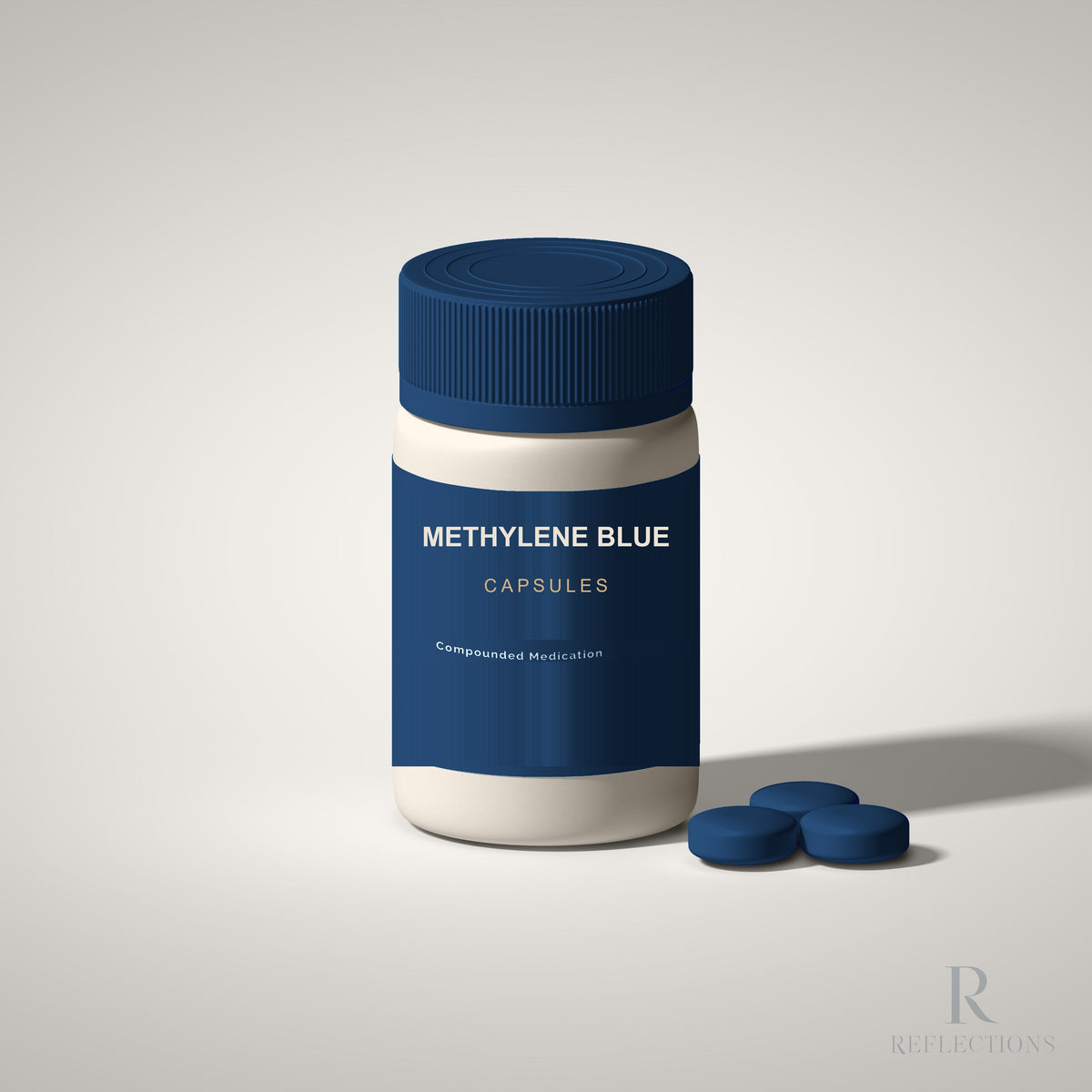
🔵 Methylene Blue Capsules
Old drug, new question.
What it is, in plain English
Mitochondria make energy by passing electrons down a chain. When that chain runs poorly — with age, with illness, under stress — output falls. Methylene blue can accept and donate electrons directly, effectively providing a bypass around a sluggish step. That property is why a 19th-century textile dye ended up in modern research on brain energy metabolism.
How it helps
- 🔋 Acts as an alternative electron carrier in mitochondria
- 🧠 Studied for memory and cerebral oxygen consumption
- 🧪 A century-long safety record at pharmaceutical doses
- 💊 Oral capsule — no needle, no mixing
Why people reach for it
Interest in methylene blue sits alongside NAD+ for the same reason: both are aimed at mitochondrial output rather than at a hormone or an appetite signal. People already running NAD+ often add it as the second lever on the same system.
| NAD+ | Methylene Blue | |
|---|---|---|
| Target | NAD+ pool and sirtuin signalling | Electron transport chain directly |
| Route offered here | Injection, patch, sublingual, nasal | Oral capsule |
| Research base | Modern, still emerging | Over a century of clinical use |
Two things worth knowing
Methylene blue stains — it will tint urine blue-green, and it can stain the mouth if a capsule is opened. More importantly, it has meaningful serotonergic activity, which is the reason for the interaction warning below rather than a theoretical caution.
Is it a fit?
Methylene blue suits an interest in mitochondrial function and cognition, particularly alongside NAD+. Anyone on an antidepressant should treat the warning below as a hard stop until a provider has reviewed it. Take the 60-second peptide quiz or message our team, and our providers can point the way.
🔬 For the science-minded
Methylene blue (methylthioninium chloride) is a redox-cycling phenothiazine that can shuttle electrons to cytochrome c, bypassing complexes I–III. Low-dose research has examined effects on cerebral metabolic rate, memory consolidation and mitochondrial function; at high doses the redox behaviour reverses and becomes pro-oxidant, which is why the low-dose window matters. It is also a potent monoamine oxidase inhibitor.
Methylene blue is a monoamine oxidase inhibitor and can cause serotonin syndrome when combined with SSRIs, SNRIs, MAOIs, triptans or other serotonergic drugs. It is also contraindicated in G6PD deficiency. Anyone taking an antidepressant must clear this with a provider before starting.
Educational only — not medical advice. Peptides discussed here are research compounds; whether any is appropriate is a decision between a patient and their licensed provider.
Full access unlocks with a free patient account. Create yours in under a minute — or take the 60-second peptide quiz and we’ll email your matches with a private link.
New patients get $20 off over $75 — or 20% off over $200 — applied automatically at checkout once registered.
Not sure this is the right peptide for you?
Take the 60-second Peptide Match Quiz — it scores your goals against our full anti-aging lineup.
Research & Experimental Notice
Many peptides are investigational compounds. Uses described here are not FDA-approved, and statements have not been evaluated by the FDA. Information here is provided for education only.
Five-star rated
by our patients
Provider-led
clinical team oversight
Johnson City, TN
+ virtual care in 7 states